
 ............It
Might Be Too Late For ManKind.
AQUARIUS
UNDERWATER
The
advantages of saturation diving for scientists
............It
Might Be Too Late For ManKind.
AQUARIUS
UNDERWATER
The
advantages of saturation diving for scientists
Aquarius scientists escape the limitations of conventional surface-based scuba diving through the use of a special technique
called saturation diving. The most serious threat divers face when working underwater is related to "decompression sickness,
" also known as "the bends." Decompression sickness is caused by bubbles that form in the blood and tissues when divers
stay down too longat a given depth, then ascend to the surface too fast. The bubbles get caught in joints and vessels, causing
many symptoms that can include pain, paralysis, and ultimately even death. Instead of coming to the surface after diving,
scientists who use Aquarius return directly to the undersea laboratory. As long as the Aquanauts don't go back to the surface
they can use special dive tables to greatly increase their bottom time - to nearly ten times over what they typically have using
conventional surface-based diving techniques. Without Aquarius, researchers are forced to make multiple dives of short
 duration from the surface, which also leaves them vulnerable to the complications of daily boat trips, unpredictable weather,
difficulties setting up seafloor experiments that requirepower and computers from the surface, and frequent deep dives that
increase the likelihood of getting the bends. At the end of each mission, aquanauts go through a 17-hour "decompression,
" where the pressure inside Aquarius is slowly reduced from ambient (the pressure at the working depth of Aquarius is 2.5
times surface pressure, or nearly 44 pounds per square inch) back to surface pressure (14.7 pounds per square inch).
At the end of decompression the aquanauts "blow down" back to ambient depth in the entry lock, are met by ascent divers
 in the wet porch, and are escorted to the surface where they are picked up by boats and returned to shore.

Additional advantages provided by the Aquarius saturation system include the sophisticated power and communication
 capabilities of the habitat. Experiments can be set up on the reef similar to what might be accomplished back at a shore-
based laboratory bench. A recent mission powered high resolution infrared video cameras to record coral feeding biology,
with recording decks inside Aquarius. Aquarius also provided power for the red lights to prevent unusual concentrations of
plankton from developing. Further, plankton pumps were deployed at multiple depths in the water column, and divers out on
the reef communicated with scientists back in the habitat to coordinate sampling and collecting schedules. Scientists also have
email, telephone, and video conferencing capability to anywhere in the world. During another recent mission, a shore-based
scientist had a complete mock-up of gear deployed from Aquarius, and was able to trouble shoot and solve equipment
problems during the mission using data transmitted in real-time from Aquarius.

Scientists who study coral reefs need to work underwater. But bottom time is not the only limitation, cost is also important.
The cost of running Aquarius compared to surface-based operations provides an interesting contrast. Conducting research
on or under the ocean is expensive. Bottom time conversions from saturation missions to surface-based programs suggest
that it would take at least 60 -70 days to match the same bottom time as a ten-day saturation mission. Sixty days in the field
with a team of four divers can approach $70,000 ($900/day for a boat and dive support, $120 day per diem for four
people, and $120/day hotel expenses for two rooms). Further, at the depths worked from Aquarius, surface-based diving
is more rigorous than saturation diving. On a day-to-day basis, four divers could not possibly work more than 6 days without
 at least one day off, and over the course of several weeks additional time off is necessary. Larger dive teams could get
around this problem, but costs would also increase. Repetitive deep diving schedules also expose divers to greater risk
of decompression sickness than saturation diving.

So, how does Aquarius compare? One way to draw a comparison is to contrast the daily cost of Aquarius operations
 with the above surface-based cost estimates - assuming that the work could even be conducted from the surface, which in
many cases is not possible. Ten days in Aquarius costs $100,000, or about $30,000 more than a surface-based project.
This is not insignificant. However, few academic scientists have 60 days available to spend in the field, so getting a lot of
work done in a short amount of time is another beneficial aspect of the Aquarius program. Finally, Aquarius provides
significant media access and public outreach capabilities that are not possible in conventional dive operations, and while
 the program's science mission is paramount these other activities are also valuable.
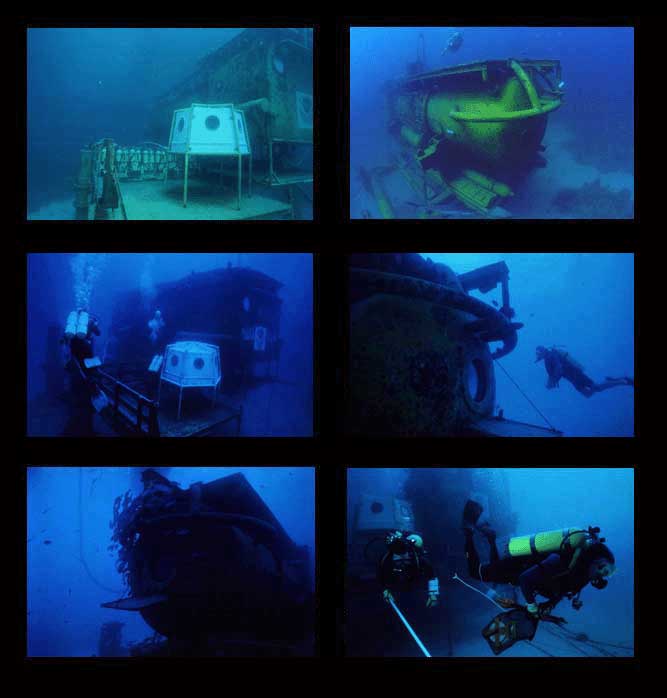 AQUARIUS
LOCATION
AQUARIUS
LOCATION
 Home | Email
 © 1998,
1999, 2000, 2001, 2002, 2003, 2004, 2005, 2006, 2007, 2008, 2009,
Garie Sim All rights reserved.
© 1998,
1999, 2000, 2001, 2002, 2003, 2004, 2005, 2006, 2007, 2008, 2009,
Garie Sim All rights reserved.